Drake Landing Solar Community, Okotoks, Canada
Centralized solar thermal system for 52 homes using garage roof mounted flat panels and underground thermal storage. Reduction in heating needs quoted at 90%
http://www.dlsc.ca/borehole.htm
Borehole Thermal Energy Storage (BTES)
|
A borehole thermal energy storage (BTES) system is an underground structure for storing large quantities of solar heat collected in summer for use later in winter. It is basically a large, underground heat exchanger.
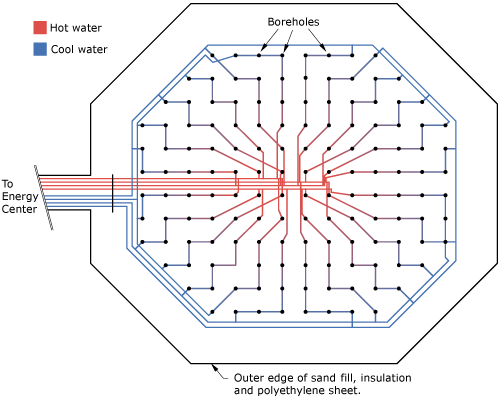
A BTES consists of an array of boreholes resembling standard drilled wells. After drilling, a plastic pipe with a “U” bend at the bottom is inserted down the borehole. To provide good thermal contact with the surrounding soil, the borehole is then filled with a high thermal conductivity grouting material.
Aerial view of Borehole Thermal Energy Storage (BTES)
Sideview of single Borehole Thermal Energy Storage (BTES) tube |
 |
Click for a larger image >> |
The BTES in the Drake Landing Solar Community (DLSC) consists of 144 boreholes, each stretching to a depth of 37 meters and planned in a grid with 2.25 meters between them. The BTES field covers 35 metres in diameter. At the surface, the U-pipes are joined together in groups of six that radiate from the center to the outer edge, and then connect back to the Energy Centre building. The entire BTES field is then covered in a layer of insulation and then soil – with a landscaped park built on top.
When solar heated water is available to be stored, it is pumped into the centre of the BTES field and through the U-pipe series. Heat is transferred to the surrounding soil and rock, and the water gradually cools as it reaches the outer edge and returns to the Energy Centre.
Conversely, when the homes require heat, cooler water is pumped into the edges of the BTES field and as the water flows to the centre it picks up heat. The heated water passes to the short-term storage tank in the Energy Centre and is then circulated to the homes through the district heating loop. All pumps and control valves are housed in the neighbouring Energy Centre building.
Even with sunny Alberta weather, it will take approximately three years to fully charge the BTES field. In the first years of operation, the field will operate at relatively low temperatures, and the recoverable energy will be largely depleted before the end of the heating season. However, after a few years of operation, the core temperature of the BTES field will approach 80°C by the end of summer, with sufficient heat for almost an entire heating season.

The Energy Centre
 The 2,500 square foot Energy Centre building for the Drake Landing Solar Community (DLSC) is the heart of the district heating system. Located in the corner of the community park, it houses the short-term heat storage tanks and most of the mechanical equipment such as pumps, heat exchangers, and controls. The solar collector loop, the district heating loop, and the borehole thermal energy storage loop pass through the Energy Centre.
Approximately 70 percent of the floor space is filled with two large, horizontal, insulated water tanks, each 12 feet in diameter and 36 feet long. The water temperatures within these tanks are stratified to improve the overall efficiency of the system.
The front room of the Energy Centre contains the pumps, valves, heat exchangers, expansion tanks, and other equipment necessary to operate and control the energy system.
Stratified Short Term Thermal Storage (STTS) Tanks and Solar Collector Loop
STTS:
|
The District Heating System
|
Plastic, insulated, underground pipe is used to distribute heated water from the community’s Energy Centre back to the homes. The hot water circulating through these pipes will typically be 40 - 50°C. The distribution temperature will vary through the year based on the outside air temperature and the flow regulated to match demands by the homeowners.
This lower temperature reduces losses from the pipes and is more compatible with the solar energy source. Keeping the system operating temperature as low as possible causes the solar collectors to operate in a more efficient manner, thus increasing the total quantity of heat available for delivery to the homes.
Because of a lower water temperature used in the district heating system, each home is equipped with a specially designed air-handler unit for adequate heat distribution.
Drake Landing Solar Community Site Plan
Solar Collection
|
The solar thermal collection system consists of 800 flat plate solar panels organized into four rows mounted on the detached garages behind the homes.
An antifreeze solution - a mixture of water and non-toxic glycol - is pumped through the solar collectors and heated whenever the sun is out. The 800 collectors are connected via an underground, insulated pipe that carries the heated solution to the community’s Energy Centre. Once there, the heated solution passes through a heat exchanger, where the heat is transferred to the water in the short-term storage tanks. While the flow rate through the collectors is constant, the flow rate on the water side of the heat exchanger is automatically adjustable, allowing the control system to set a desired temperature rise.
The solar collectors for DLSC were manufactured by Enerworks.
Solar Collector Cross-Section


1 comment:
Thanks for sharing this amazing post with us.
Post a Comment